Why Am I Hungry on Day 5 of Tirzepatide?
Written by Dan Cripe, RN, BSN & Marcia Cripe, RN
This article is for educational purposes and does not replace medical advice. Consult a qualified healthcare provider for guidance specific to your health, medications, or treatment.
Waking up hungry on day 5 or 6 after your tirzepatide injection does not mean the medication has stopped working or that your dose is inadequate. There is a clear pharmacological reason for this shift: tirzepatide has an elimination half-life of approximately five days. While the drug remains active in your system for the full week, circulating concentrations naturally peak early and begin a gradual downward slope toward the end of your dosing window.
A drop in drug concentration changes the intensity of receptor activation in your brain and gut. For many people, that lower late-week exposure is felt as a gentle return of physical appetite.
The Weekly Curve: Waves, Not On/Off Switches
Tirzepatide is absorbed gradually after a subcutaneous injection, reaching its peak blood concentration between 8 and 72 hours. From that peak, circulating levels slowly decline until your next injection.
Because of its five-day half-life, weekly doses overlap. You reach a pharmacokinetic steady state after about four weeks, meaning you never reset to zero. However, steady state is not a flat line; it is a continuous repeating wave.
Weekly Tirzepatide Concentration Wave
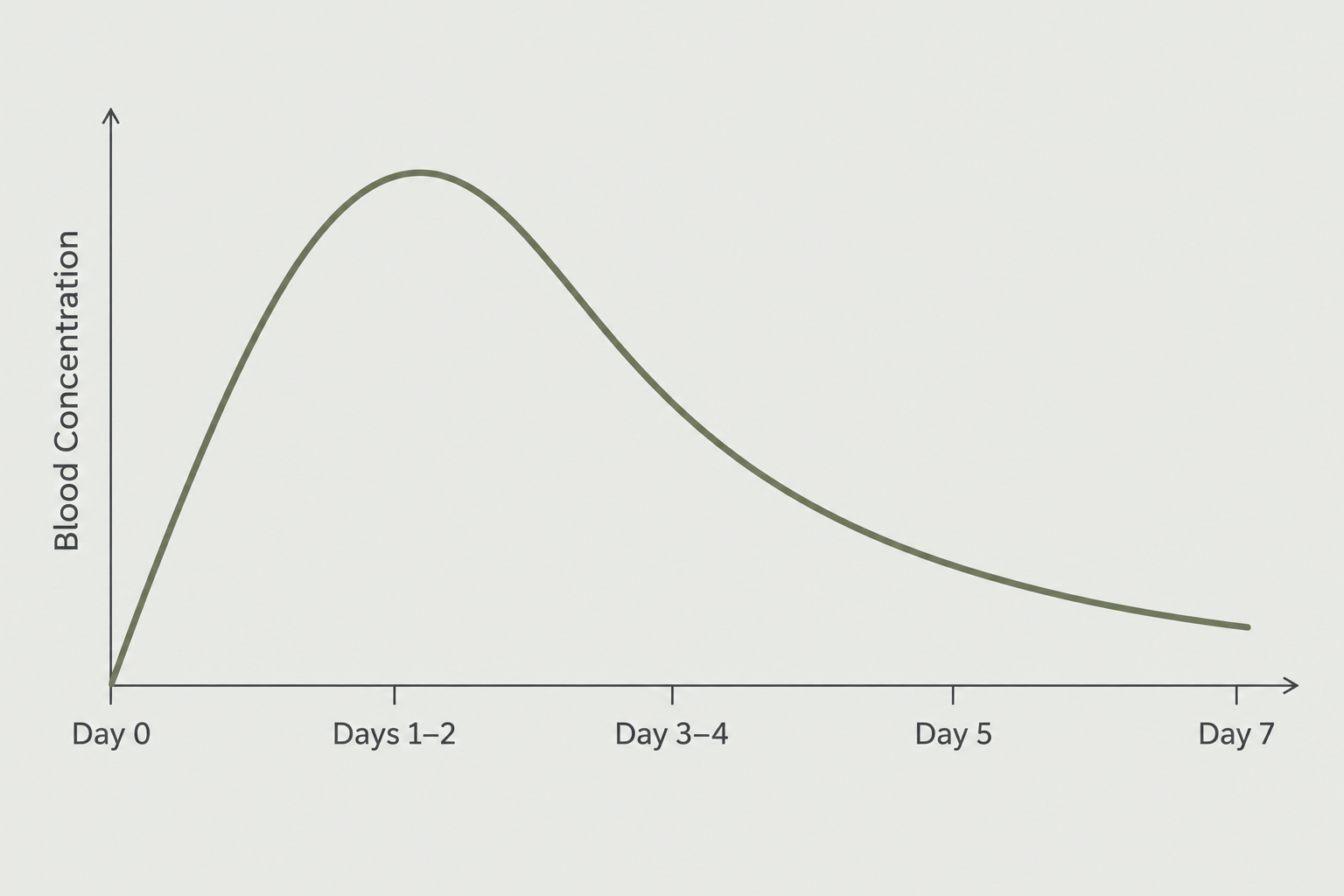
Day 5 sits directly on that downward side of the wave. If your brain’s satiety signaling is particularly sensitive to shifting drug exposure, you will feel that concentration drop as real hunger.
Tirzepatide Does Not Reset to Zero Every Seven Days
A common misunderstanding is assuming that because tirzepatide has a five-day half-life, the medication is completely gone by day five. In pharmacology, half-life simply measures the time it takes for half of an active dose to be eliminated from your system.
Because you inject once every seven days, each new dose stacks directly on top of medication remaining from previous weeks. By week four of a consistent dose, you reach what pharmacologists call "steady state".
At steady state, your baseline exposure remains therapeutically active even on the morning of your next shot. You are never resetting to zero; you are simply experiencing the lower exposure point of an ongoing, continuous wave.
Hunger, Satiation, and Food Noise Are Not the Same
A common point of confusion is feeling hungry on day 5 while still getting full unusually fast once you sit down to eat. This happens because starting a meal (hunger) and stopping a meal (satiation) involve overlapping but distinct biological pathways.
As nurses, we remind people that experiencing genuine physical hunger is healthy biology, not a clinical failure. The goal of GLP-1 therapy is metabolic regulation, not the permanent elimination of all human appetite.
Metabolic Pressure: Why the Body Fights Back
If you have already lost substantial weight, your late-week hunger may feel more pronounced than it did during your first month of treatment. This is driven by adaptive thermogenesis and counter-regulatory hormones.
When your body loses fat mass, circulating leptin drops and your brain increases the biological drive to eat. Tirzepatide works against that pressure, but the two forces are in constant negotiation.
When drug concentrations dip toward the trough on days 5 and 6, your body's natural defense against weight loss surfaces more easily. This does not mean your dose is suddenly useless; it simply reflects the interplay between pharmacology and metabolic adaptation.
The Nurse-Approved Late-Week Plan
Instead of treating day 5 hunger as an emergency or asking for an immediate dose increase, use that predictable downward curve to your advantage. Here is the clinical routine we recommend to manage the end of your dosing week:
- Track the Full Pattern: Record your symptoms for three consecutive weeks to confirm whether you are experiencing true physical hunger, returning food noise, or increased portion sizes.
- Plan Higher-Volume, Lean Protein: On days 5 and 6, structure meals around high-volume, lean protein and high-water vegetables to trigger physical stretch receptors without heavy calories.
- Respect Early Fullness: When physical hunger prompts you to eat, pause halfway through your plate. You will likely find your stomach still signals satisfaction much sooner than it did before starting treatment.
- Avoid Impulsive Dose Jumps: Discuss late-week patterns with your prescribing provider before requesting a titration, especially if your overall monthly weight loss and metabolic markers remain on track.
- Check Secondary Triggers: Evaluate whether poor sleep, dehydration, intense workouts, or inadequate calorie intake on days 1 through 3 are exaggerating your day 5 rebound.
SOURCES & REFERENCES +
- U.S. Food and Drug Administration. Zepbound (tirzepatide) Prescribing Information. Pharmacokinetics: absorption, maximum plasma concentration, elimination half-life, and steady-state exposure.
- Schneck, K., Urva, S., et al. Population pharmacokinetics of the GIP/GLP receptor agonist tirzepatide. CPT: Pharmacometrics & Systems Pharmacology, PMID: 38356317. (2024)
- Martin, C. K., Carmichael, O. T., Carnell, S., et al. Tirzepatide on ingestive behavior in adults with overweight or obesity: a randomized 6-week phase 1 trial. Nature Medicine, PMID: 40555748. (2025)
- Kennedy, S. F., Knights, A., Ravussin, E., et al. Impact of tirzepatide treatment on participant-reported food craving and food preference. Diabetes, Obesity and Metabolism, 27(11), 6784–6789. (2025)
- Jastreboff, A. M., Aronne, L. J., Ahmad, N. N., et al. Tirzepatide Once Weekly for the Treatment of Obesity. New England Journal of Medicine, 387(3), 205–216. (2022).
- Sumithran, P., Prendergast, L. A., Delbridge, E., et al. Long-term persistence of hormonal adaptations to weight loss. New England Journal of Medicine, 365(17), 1597–1604. (2011).
- Nymo, S., Coutinho, S. R., Eknes, P. H., et al. Investigation of the long-term sustainability of changes in appetite after weight loss. International Journal of Obesity, 42, 1489–1499. (2018).
- Martins, C., Roekenes, J., Salamati, S., et al. Metabolic adaptation is associated with a greater increase in appetite following weight loss: a longitudinal study. American Journal of Clinical Nutrition, PMID: 37863431. (2023).
- Bettadapura, S., Dowling, K., Jablon, K., et al. Changes in food preferences and ingestive behaviors after glucagon-like peptide-1 analog treatment. 9. International Journal of Obesity, 49(3), 418–426. (2025).